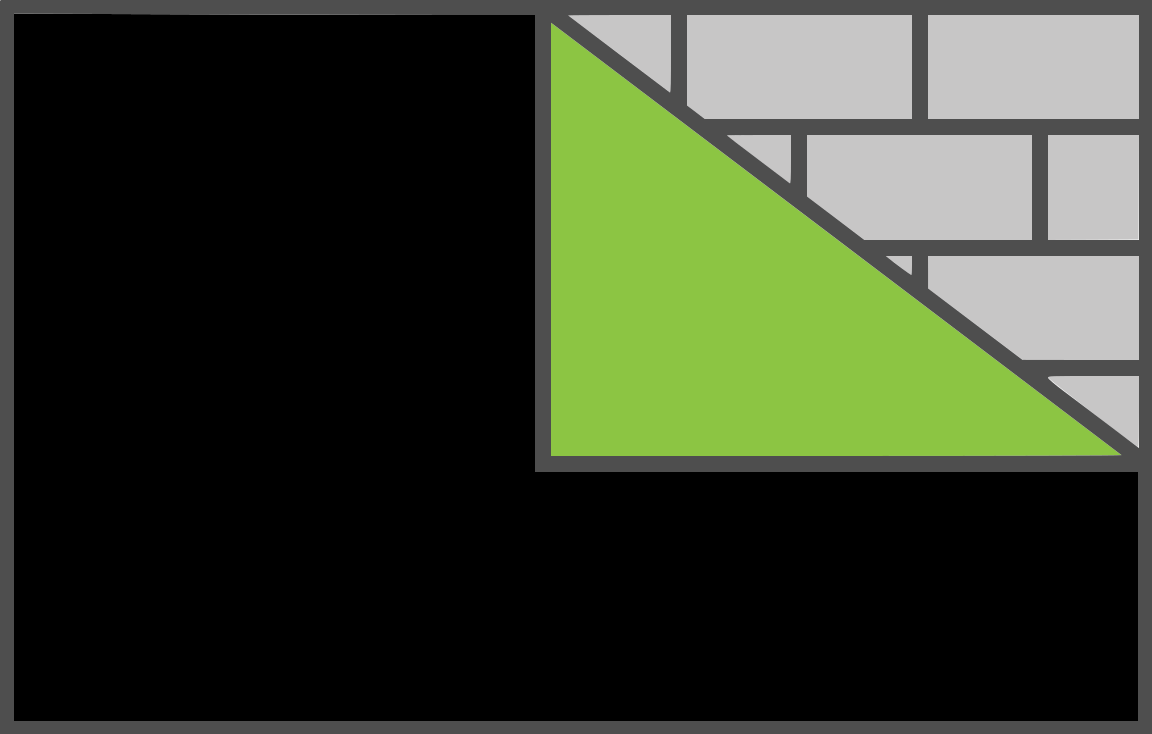
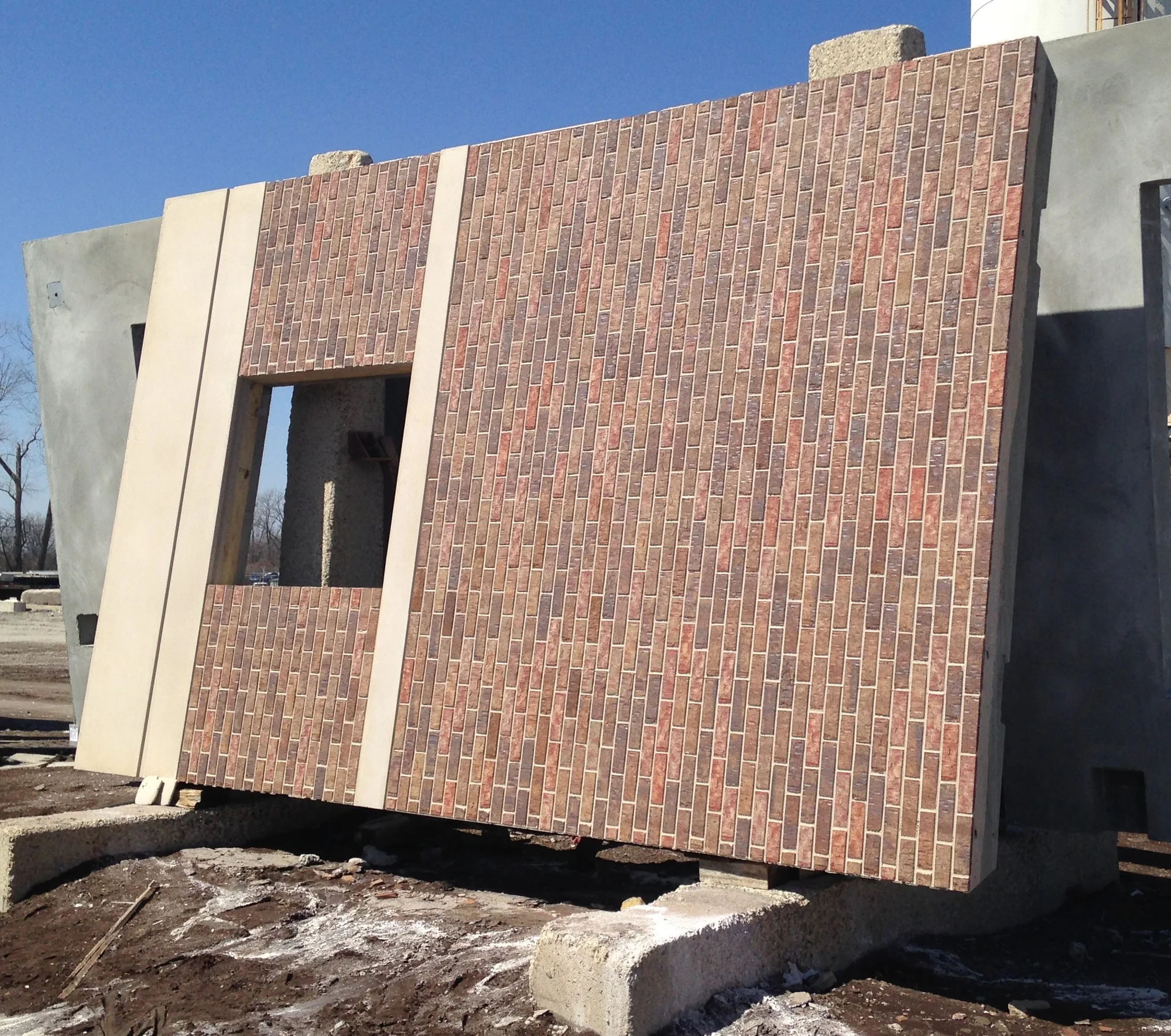
Brick in the panel, held by bond
The brick goes into the liner face down and concrete is cast against its back.
What holds the brick.
| Connection | Bond between the back of the brick and the cast concrete. No mechanical anchor. |
|---|---|
| Back surface texture | A specified item: scored, combed, wire roughened, ribbed, keybacked, dovetailed. |
| Pull-out strength | Not less than 150 psi from the base concrete, on assembled specimens, before and after 300 freeze thaw cycles, under the PCI Specification for Embedded Clay Thin Brick. |
| Brick position | Face down in the liner. Concrete is cast against the back. |
The assembly.
| Water | A clay product-faced precast panel acts as a rain barrier. The joints between panels take the work of the cavity. |
|---|---|
| Items not needed | Dovetail anchors, flashing and weep holes, per DN-25. |
| Bowing | A clay face on one side of a concrete section moves differently through temperature and moisture. The producer designs for it. |
| Ledge | A liner pocket sized for one brick and filled with another leaves a ledge at the joint rib. |
Settle before tooling.
- The liner that fits this brick
- The pocket matches the brick dimensionally. Flex2Fit models are documented against real brick size ranges. Match a brick to a liner →
- Single use or multi use
- Solocast is single use. Flex2Fit is multi use and runs again across pours. Compare the systems →
- Brick that is not uniform
- Flex2Fit seals around brick that varies in size, shape and texture, with no ledge. How Flex2Fit seals →
- The brick count and the sheet count
- The calculators use the real sheet sizes and the coursing for the format you pick. Count the brick →
Common questions.
- How is thin brick held in a precast panel?
- By bond alone. The brick sits face-down in a rubber liner, concrete is cast against the back of it, and the concrete keys into the back-surface texture of the brick. There is no mechanical anchor, which is why the PCI specification requires pull-out strength of 150 psi both before and after freeze thaw cycling and names back-surface texture as a specified item.
- Is embedded thin brick the same as adhered thin brick veneer?
- No. Adhered veneer is applied to a finished wall on site with mortar or an adhesive system over lath or backer board. Embedded brick is cast into the panel at the plant, so the brick and the concrete cure as one unit and arrive at the site already finished. Most thin brick published online is about the adhered method, and the requirements are not interchangeable.
- Can I use any thin brick for precast?
- Only brick supplied for embedded work. A brick can meet the general standards for veneer and still fail once it is cast into concrete, because the assembly is tested differently. Ask for documentation against the PCI Specification for Embedded Clay Thin Brick in PCI RP 152-25.
- Does the brick work happen at the plant or on site?
- At the plant, flat, at bench height, under a roof. The panel arrives at the site with the brick and the joints already in the face, and the crew sets it with a crane.
- What sets the joint width and profile?
- The liner does. Joint width and profile are cast by the liner, so they are decided when the liner is chosen. That is worth settling on paper early, because changing it later means changing tooling.
Projects.

More thin brick reference.


Request a sample.
Send your rep the brick, the coursing and the panel size for a liner recommendation.